



Ready to kickstart your next big project?
Let's innovate together.
The software industry has always been shaped by obsolescence. Waterfall gave way to Agile. On-premise infrastructure yielded to the cloud. Manual testing fell to automated pipelines. Each wave didn't just introduce new tools — it took entire methodologies and put them to bed. We're now standing at the crest of another such wave, and this time, it is the Software Development Lifecycle (SDLC) itself that is being fundamentally reimagined. Enter the Agentic Development Lifecycle (ADLC) a development methodology in which AI agents autonomously handle significant portions of the software creation process.
ADLC Meaning: A New Paradigm for Software Creation
The ADLC meaning is straightforward in definition, but quite a bit more complex in its implication, running the gamut from requirements analysis and architecture through implementation, testing, and deployment, with human engineers operating as orchestrators, reviewers, and decision-makers rather than old school line-by-line coders.
Where the traditional SDLC assumed that human devs were the primary unit of production, the Agentic Software Development Lifecycle assumes that AI agents are (quite a different way of thinking about things). This isn't a subtle shift in tooling, that's the not best way to imagine it from a business, tech, or developer perspective. What it is is a categorical change in how software gets built.
One note before we get into the meat of the topic. For many, ADLC is used to describe how agent products are built, there are some well-circulated articles that may be familiar to those of you out there who have already researched the topic. For our purposes, we use it to describe how agents are transforming the way all software gets built.
As one Microsoft engineer recently put it, reflecting on building an end-to-end agentic SDLC with Azure and GitHub: many core skills taught in software engineering degrees (think manual requirements translation, step-by-step debugging, hand-crafted architecture diagrams) are already becoming a thing of the past. Not because they are unimportant in principle, but because agents can now perform them much faster, more consistently, and at greater scale.
What Is Becoming Obsolete — And Why
Tech obsolescence in software development is rarely about tools becoming "bad." It's about the cost-benefit ratio shifting so dramatically that holding onto the old approach becomes a crutch.
Consider what the traditional SDLC requires — weeks of requirements gathering, manual sprint planning, hand-written unit tests, human-led code reviews of every pull request, and humdrum post-deployment monitoring that eats up time. In an ADLC model, AI agents compress or entirely get rid of many of these activities:
- Requirements and specifications are generated and refined by agents in minutes, not weeks
- Code scaffolding and implementation emerge from natural language descriptions via spec-driven development
- Testing shifts from manual test writing to autonomous evaluation loops that continuously probe system behavior
- Observability and debugging are handled by SRE agents that surface anomalies and suggest remediations in real time
The result is that the bottleneck in software delivery moves from "how fast can devs write and review code?" to "how well can our team define outcomes and evaluate agent behavior?" Reference the handy table below to better understand the difference between traditional SDLC, PDLC and ADLC.
| Dimension | Traditional SDLC | PDLC | ADLC |
| Scope |
Engineering only Covers the software build process — requirements to deployment. Product strategy and design are handled separately upstream.
|
Full product journey Expands the lifecycle to include strategy, discovery, UX design, engineering, and go-to-market — breaking down silos between disciplines.
|
Full product journey, AI-executed Retains the broad scope of PDLC but replaces manual execution across disciplines with autonomous AI agents, governed by human orchestrators.
|
| Execution unit |
Human developer Individual engineers write, review, and ship code. Throughput is bounded by team size and cognitive bandwidth. |
Cross-functional team PMs, designers, and engineers collaborate within a shared lifecycle. Human coordination replaces siloed handoffs, but execution remains manual.
|
AI agent Agents generate, test, and iterate on code. Engineers orchestrate agent behavior and validate outcomes. |
| Lifecycle model |
Linear or iterative Sequential phases — plan, design, build, test, deploy — with defined handoffs between stages and teams. |
Integrated and iterative Strategy, design, and engineering are looped together. Cross-functional feedback shortens the distance between insight and delivery.
|
Continuous flywheel Agents build, evaluate, and self-correct in rapid loops. The path from functional to reliable replaces the path from design to deploy. |
| Quality approach |
Manual QA + code review Humans read code line-by-line, write test cases, and catch defects before release. Quality is a gated phase. |
Embedded quality Quality is shared across disciplines — design reviews, user testing, and engineering QA run in parallel rather than sequentially.
|
Automated evaluation loops Agents continuously probe system behavior against defined benchmarks. Quality is an ongoing measurement, not a gate. |
| Team roles |
Builders and implementers Engineers are the primary producers. BAs translate requirements, devs implement, QA validates. |
Collaborators and owners Disciplines share ownership of outcomes — not just their own workstream. PMs, designers, and engineers align around product goals rather than functional deliverables.
|
Orchestrators and evaluators Engineers define intent, write precise specs, review agent outputs, and govern system behavior. Implementation is delegated. |
| Governance |
Process-based oversight Governance happens through pull requests, code reviews, and release approvals. Oversight is human and synchronous. |
Shared accountability Governance extends beyond code — roadmap decisions, design principles, and launch readiness are owned collectively across functions.
|
Automated guardrails Continuous observability, human-in-the-loop review gates, and automated guardrails manage emergent agent behavior in real time |
The Three Pillars of the Agentic Development Lifecycle
While implementations can take many forms, ADLC frameworks share a pretty common structure across three phases.
1. Planning and Alignment
This phase looks superficially similar to traditional project initiation, but with a critical difference, the output is not a backlog of tickets, it's a machine-readable specification. Spec-driven development sits at the heart of ADLC. Rather than translating business requirements into Jira stories and hoping developers can digest them, teams produce structured specifications that agents can parse, question, and execute against. The human role here is sharpening intent, not translating it into tasks.
It must be pointed out – one thing agents don't compress is the chunk of time it takes for business teams, product owners, and technical leadership to align on what to build and why. In enterprise environments, that cross-functional alignment is more often than not the real bottleneck, not the documentation that follows it. ADLC speeds up everything downstream of that agreement. The alignment itself is still up to teams and organizations, and arguably becomes even more crucial when agents can execute at speed, because misaligned intent at machine speed creates problems at machine speed too.
2. The Build and Evaluation Flywheel
This is where ADLC take a left turn away from its predecessor. In a conventional SDLC, reaching "feature complete" was most of the battle we fought. In ADLC, getting to a functionally complete state is relatively fast — the real work is iterating from functional to reliable. Agents build, test, surface failures, and propose fixes in continuous loops. Human engineers evaluate outputs against defined behavioral benchmarks rather than reading through code line by line. Quality is measured against outcomes, not outputs.
3. Governance and Production Oversight
Because agents can exhibit emergent behaviors that weren't explicitly programmed, ADLC places big-time emphasis on automated guardrails, human-in-the-loop review gates, and continuous observability. This is not optimal — it is the mechanism by which AI-generated software earns and maintains trust in production environments.
Spec-Driven Development: The Language of ADLC
One concept deserves particular attention in what we're talking about here — spec-driven development. In an agentic workflow, the specification is not a document that gets handed off and forgotten. It is a living artifact that acts as the motor for agent behavior from point A to point B in the lifecycle. Agents reference the spec to generate code, validate outputs, and flag discrepancies between intended and actual behavior.
This places new demands on product and engineering leadership. Writing a good spec for human developers requires clarity. Writing a good spec for agents requires precision, completeness, and structure machines can interpret. Teams that master this skill will find themselves with the full power of the Agentic Software Development Lifecycle.
ADLC Is Not the End of Software Engineering — It's Just Its Next Form
It would be easy, haphazard, and just plain wrong to read the rise of ADLC as a story about replacing engineers. Rather, it's a story about what engineering mastery will mean as we move forward.
The engineers who thrive in an ADLC world will be those who can exercise their own judgment about when to trust autonomous systems and when to take matters into their own hands. These are deeply human skills, but skills that are applied at a higher level of abstraction than, say, writing functions or debugging stack traces.
The obsolescence we're seeing at this moment is not of software engineers, it's of the manual (dare we say boring?) processes that have historically made software development slower and more expensive than it actually needs to be.
Partnering for the ADLC Transition
The shift to an Agentic Software Development Lifecycle is not light switch you can flip 💡 it's a transformation that teams across all industries will need to navigate. It requires rethinking team structures, development workflows, tooling choices, governance models, and the very metrics by which software delivery is measured.
At PALO IT, we work with organizations at every stage of this transition. Whether you're exploring what ADLC means for your engineering teams, piloting agentic orchestration on a specific product, or redesigning your delivery model, we already have over two years of enterprise deployments under our belts, working with business ranging from transportation, insurance, healthcare and more. Our ADLC methodology, Gen-e2™, is powered by our high-level partnerships Microsoft and GitHub, and has helped our enterprise clients focus their time and energy on strategic tasks, with 95% of code, user stories, documentation, technical implementation plan, tests, infra as code generated by AI.
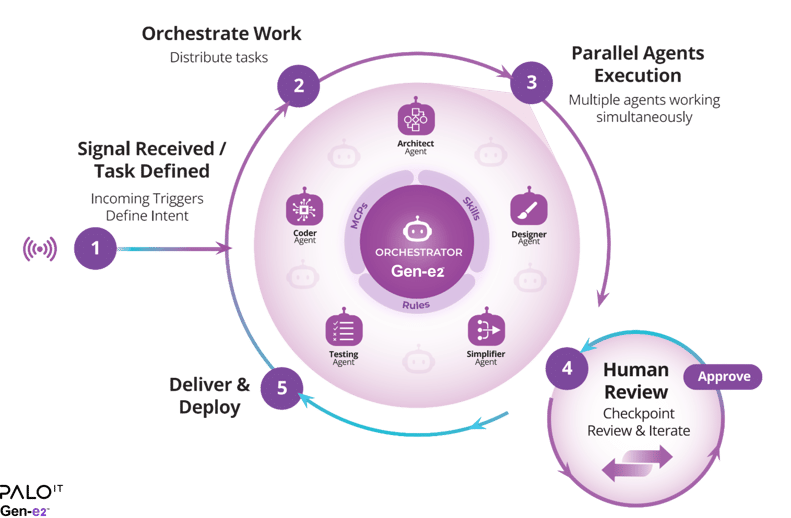
The next lifecycle of software development is already underway — and the organizations that engage with it deliberately, rather than reactively, will be the ones that define it.
Interested in exploring how the Agentic Development Lifecycle can transform your software delivery? Get in touch.