



AGENS ET DISCIPLINA
1. Executive Summary
AI agents are becoming the next expectation for AI-first product delivery (PDLC)
AI agents are becoming the next major shift in enterprise product and software delivery. In this paper, PDLC refers to the product delivery life cycle: the end-to-end flow from shaping and building software products through testing, release, and operational readiness. What is changing is not simply that models are getting better, but that they are moving from isolated assistance to coordinated execution: many agents acting across shared context, tools, workflows, and controls. For large enterprises, this is not just a tooling trend. It is a new operating challenge, because the value created by agentic systems now depends less on the model alone and more on the harness around it.
That raises a strategic question for enterprise leaders: how do you scale autonomous agents without losing control, quality, auditability, or economic discipline? The answer is no longer just better prompting or stronger models. It requires a more deliberate approach to context, execution, verification, governance, and review - especially in environments where the consequences of drift, weak controls, or poor context can propagate quickly across teams, systems, and regulated processes.
This paper is written for leaders navigating that shift in enterprise product and software delivery. It is grounded in 30 projects delivered over 2 years of work with large enterprises deploying and scaling GitHub Copilot and generative AI across the PDLC via our Gen-e2 (GenerativeAI Enhanced Engineering) methodology.
It explains what agentic orchestration means in a delivery context, why context engineering and harness design have become strategic for the enterprise in 2026, how cloud-scale autonomy changes blast radius and risk, why token economics and first-pass quality must be managed together, and what practical strategic actions organizations can take to scale agentic systems with stronger control, better outcomes, and sustainable ROI. It is not intended as a universal treatment of every enterprise agent use case; its focus is governed agentic execution in software and product delivery environments.
2. The Argument In Six Ideas
The six ideas that explain where agentic value, risk, and control now sit
Before going deeper, it is useful to make the structure of the argument explicit. The points below are the six ideas that organize the rest of this paper: together, they explain why agentic orchestration matters for large enterprises, where the main sources of value and risk now sit, and what leaders need to pay attention to as these systems move from isolated experiments to scaled operating models.
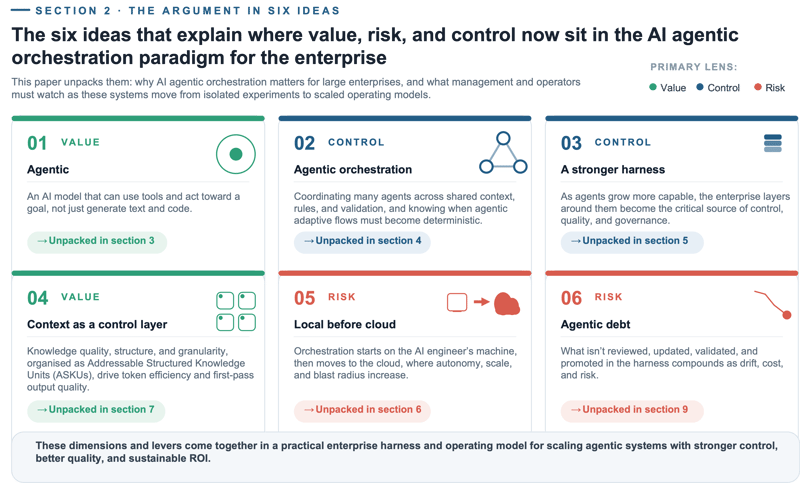
- Agentic: what it means when an AI model can use tools and act toward a goal rather than only generate text.
- Agentic orchestration: coordinating many agents deliberately across shared context, rules, and validation, while knowing when adaptive agentic behaviour should give way to deterministic workflows.
- A stronger harness: as agents become more capable, the enterprise layers around them become the critical source of control, quality, verification, and lifecycle governance.
- Context as a control layer: the quality, structure, and granularity of enterprise knowledge - increasingly organized through what we could call “Addressable Structured Knowledge Units” (ASKUs) - determine both token efficiency and first-pass output quality (see section 7 for the details of this concept)
- Local before cloud: orchestration starts on the developer’s machine, then moves into the cloud where autonomy, scale, and blast radius increase.
- Agentic debt: what is not reviewed, updated, validated, and promoted in the harness will compound as drift, cost, and risk.
The later sections show how these ideas come together in a practical enterprise harness and operating model for scaling agentic systems with stronger control, better quality, and sustainable ROI.
3. Concept
What "agentic" actually means
Until recently, most enterprise use of large language models followed a simple pattern: ask for an answer, receive code and text, and let a human decide what to do with it. The model could explain, suggest, summarize, or draft, but it was still largely confined to recommendation. A person remained responsible for turning that recommendation into action.
What is new now is not only that agents can take action, but that frontier platforms increasingly provide the conditions for continuous execution: native tool use, longer reasoning loops, automated sub-agent creation, background tasks, and tighter integration with enterprise systems. An agent can now move from answering a question to advancing the work itself - reading repositories, calling APIs, editing files, running checks, triggering workflows, and handing intermediate results back for review or escalation.
That shift matters because the output is no longer just content; it is behavior. Once an agent can observe, decide, act, and loop, the enterprise is no longer managing a sophisticated assistant, but a governed execution system that can shape code changes, workflow steps, approvals, evidence generation, and operational decisions within defined boundaries. This is why agentic AI cannot be understood only as a model capability. It must be understood as an execution model that requires context, rules, validation, security controls, and human oversight around it.
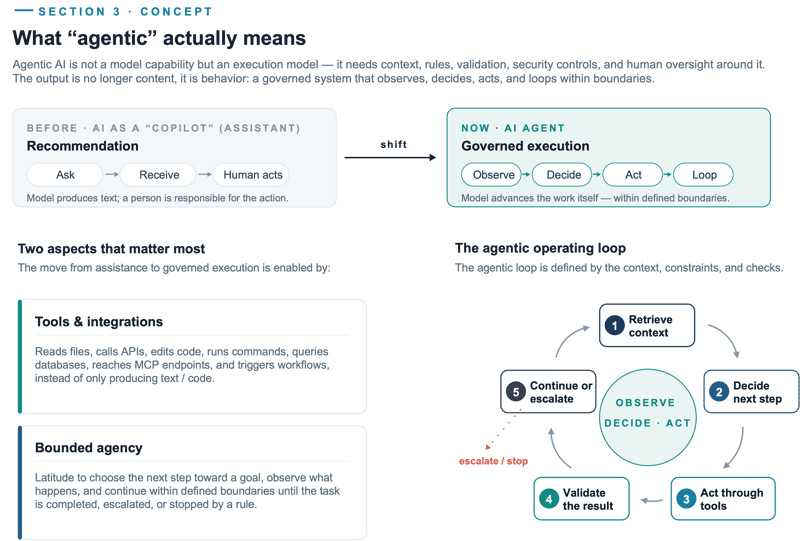
In practice, enterprise agents can have many features: memory, planning, retrieval, scheduling, background execution, collaboration with other agents, and more. For the purpose of this paper, however, two matter most because they explain the shift from assistance to governed execution:
- Tools and integrations: the ability to read files, call APIs, edit code, run shell commands, query databases, reach MCP endpoints, trigger workflows, and interact with enterprise systems rather than only produce text.
- Bounded agency: the latitude to choose the next step toward a goal, observe what happens, and continue within defined boundaries until the task is completed, escalated, or stopped by a rule.
The operating loop is simple in form but powerful in consequence: retrieve the right context, decide what to do next, act through tools, validate the result, and either continue or escalate. What changes from one enterprise to another is not the existence of that loop, but the quality of the context, the constraints around the actions, and the checks that determine whether the loop produces safe and useful outcomes.
4. Orchestration
From agents to agentic orchestration
What is changing now is not simply the existence of agents, but the move from isolated agent use to coordinated systems of agents, tools, and workflows. An organization is no longer dealing with one model answering one prompt, but with many moving parts working together across shared context, actions, checks, and decisions.
In an enterprise, agentic orchestration means deliberately organizing context, roles, tools, actions, validation, escalation paths, and review so autonomous work can happen without becoming uncontrolled. It is not just a question of how many agents are involved, but of how their behavior is coordinated, governed, constrained, and made auditable across the wider system.
This matters in enterprises because autonomy must scale with control. Some orchestration remains adaptive and agentic, especially where work benefits from exploration, interpretation, or dynamic problem-solving. But some of it must become deterministic wherever repeatability, compliance, cost control, or risk management require fixed gates and predictable outcomes. Enterprise orchestration is therefore not only about enabling agents to work together, but about deciding where flexibility is useful and where discipline must be enforced.
Gen-e2 has been evolving in exactly that direction. It began by shaping context and instructions around early copilot-style platforms so they could deliver more reliable value in delivery work. It then grew into a stronger harness of rules, structured context, verification logic, and reusable operating patterns. It is now moving toward enterprise-scale orchestration: many agents working across shared context, governed execution, deterministic workflows where needed, and continuous review over time.
That is why the next question is no longer simply how capable the agent is, but how strong the harness around the orchestration must become. As more work moves from isolated assistance to coordinated execution, context, execution discipline, verification, and review cease to be optional layers around the model and become the conditions for safe enterprise scale.
5. Architecture
As AI agents become more potent, the enterprise harness must become stronger
Once an AI agent can operate tools, it stops describing what should be done and starts doing it. Autonomy begins to look a lot like automation, with one difference: the trigger can be a person prompting in their IDE, or a signal arriving from the cloud.
As agent capabilities expand, the main risk is no longer only poor answers, but poorly governed execution. That creates a need for a stronger harness, because shallow or imprecise context can now produce unwanted outcomes at machine speed. AI agents increase both execution capacity and the speed at which consequences propagate. A well-designed harness makes it easier to detect, correct, and steer those consequences back toward a good outcome; a weak one allows error, drift, or misalignment to compound. The same is true when agents are influenced by weak, stale, or malicious external inputs: without strong boundaries and validation, the system can act on the wrong understanding with confidence.
When running locally, this is manageable: a human can see the work unfold in the IDE, and a wrong move is usually cheap to correct. In the cloud, the same pattern becomes harder to contain because agents can run unattended, touch more systems, and trigger longer chains of downstream action. The point that is already true on a laptop - that context and harness quality matter - therefore becomes even more important in the cloud, where the harness must also be more sophisticated.
For large enterprises, that harness is best understood as a stack of control layers around the agent. Some of these layers are being partially absorbed by the newest models and platforms: they can reason longer, orchestrate more steps, and verify more of their own work. But the enterprise still owns the architecture that makes those capabilities safe, economical, and relevant to its own operating environment.
In practice, the harness has four core runtime layers, with a fifth lifecycle layer underpinning them.
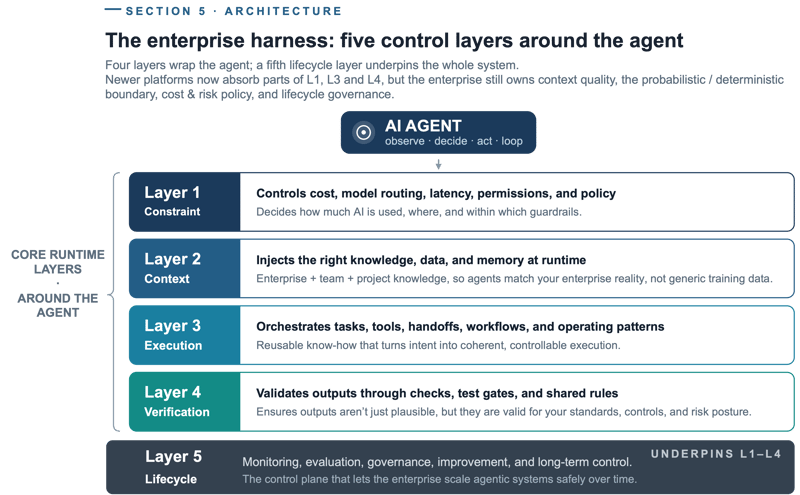
- L1 – Constraint layer: controls cost, model routing, latency, and policy, so the organisation decides how much intelligence is used and where.
- L2 – Context layer: determines what the agent knows at runtime by injecting the right enterprise knowledge, data, and memory.
- L3 – Execution layer: orchestrates how work is decomposed, delegated, and connected to tools, systems, and workflows.
- L4 – Verification layer: ensures outputs are checked, challenged, and validated before they are trusted or acted on.
- L5 – Lifecycle layer: covers evaluation, monitoring, governance, and continuous improvement across the whole system.
For a large enterprise, the central challenge is not to standardize agentic behavior to the point of rigidity, but to align it without reducing flexibility. That means giving agents the right freedom to act within clear boundaries: grounded in enterprise context, guided by reusable operating patterns, and checked against validation rules that reflect the organisation’s own standards rather than generic model behaviour.
In that model, L2 is about the quality of enterprise understanding: what the agent should know about the business domain, architecture, policies, data structures, decisions, and project context at runtime. L3 is about operational know-how: how the agent should work through delivery patterns, role instructions, methods, prompts, workflows, and tool usage that translate intent into reliable execution.
Both kinds of assets can be structured across three scopes:
- an Enterprise layer that captures reusable business and engineering intelligence,
- a Team layer that reflects the practices and conventions of a given function or squad,
- and a Project layer that captures the specific context and execution logic of one initiative.
- L4 verification then ensures that outputs are not only plausible in general, but valid for that enterprise context by applying shared harness rules, checks, and validation logic.
This is how an organization turns what is usually trapped inside one project into shared operational intelligence that can be reused, governed, and improved over time.
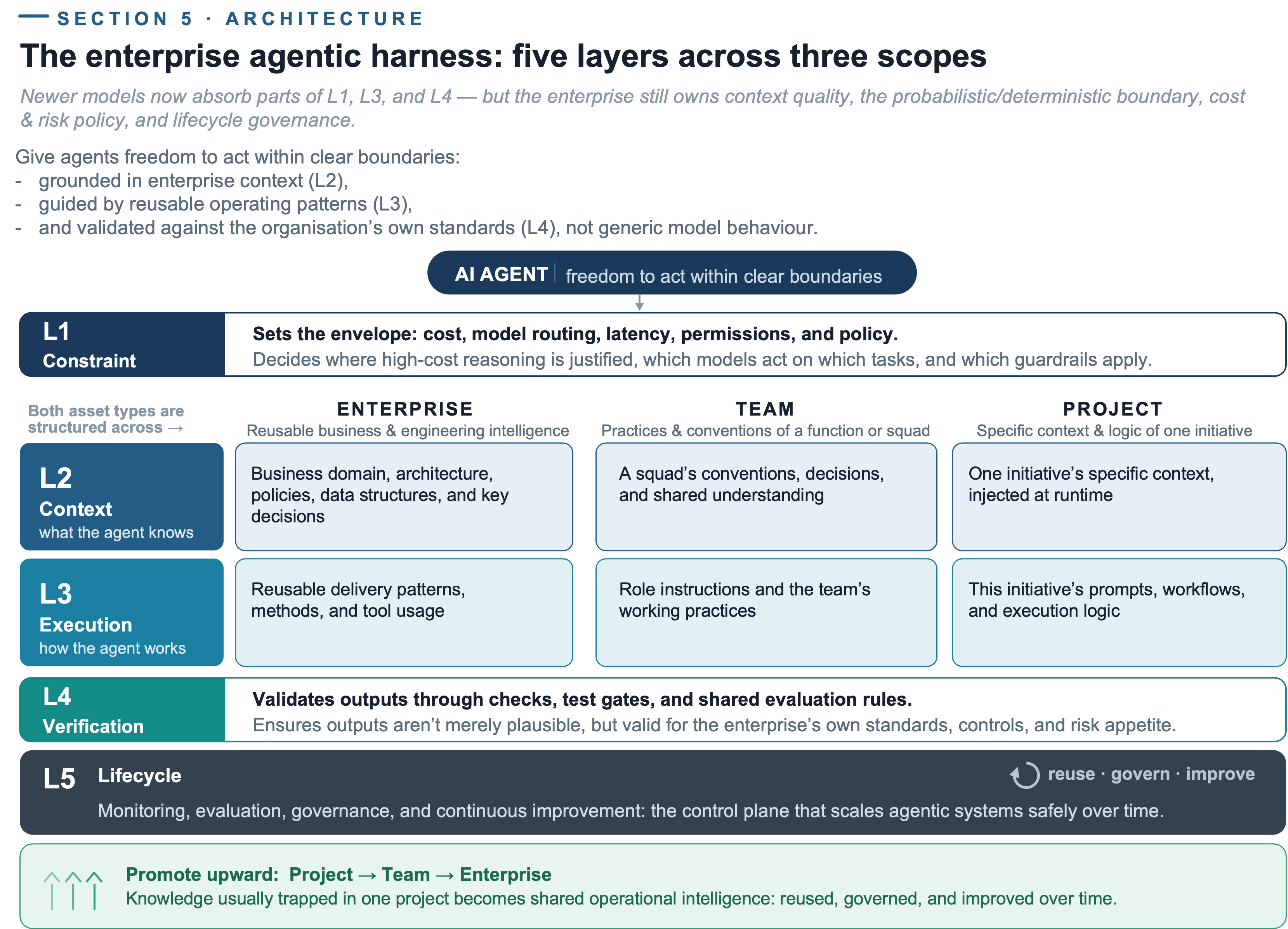
Recent model advances are not reducing the need for a harness-they are shifting and amplifying it. Newer platforms now absorb parts of the control stack: they can expose effort controls, orchestrate sub-agents, and perform a first layer of self-verification, which means some of what sat in L1, L3 and L4 is moving closer to the model.
But for an enterprise, that does not remove the need for discipline; it raises the stakes of getting the remaining layers wrong. The organization still has to own the quality of context, the boundaries between probabilistic and deterministic steps, the policies that govern cost and risk, and the lifecycle that evaluates, monitors, and improves the system over time.
This is where the enterprise harness matters most: not by competing with what the model now does natively, but by providing the architecture, governance, and operational discipline that make those native capabilities safe, economical, and useful in production. In that sense, Gen-e2 is the practical expression of this harness across delivery: a way to organise context, execution, verification, and lifecycle control so agentic systems can operate coherently at enterprise scale.
This is the real shift in agentic orchestration: the question is no longer whether agents need a harness, but where the enterprise must still exert control as models absorb more of it. As frontier platforms take on more generic reasoning, orchestration, and self-checking, enterprise value moves upward into context quality, execution discipline, validation standards, and lifecycle governance.
That also changes how enterprises should feed agents. Instead of relying on long chat sessions and tacit operator memory, organizations need structured context that agents can retrieve, reuse, and validate: specifications, transcripts, architecture, decisions, controls, and delivery artifacts. Knowledge that lives in repositories, graphs, and governed stores can scale across teams and projects; knowledge that lives in a chat window cannot. In that sense, the operating principle becomes documents over dialogue.
This is why the enterprise-grade harness is becoming the major source of differentiation in enterprise AI, not a secondary one. As frontier models absorb more generic capability, advantage shifts decisively to the enterprise layer around them: context quality, execution discipline, validation logic, governance, and lifecycle control. A good enterprise harness delivers strong ROI by reducing waste, errors, and rework. A great enterprise harness changes the economics and operating model altogether: it turns isolated agent performance into repeatable enterprise capability, and makes scale, trust, and control compound together.
6. Deployment & Risk
Adoption starts with local orchestration, before moving to cloud orchestration to scale
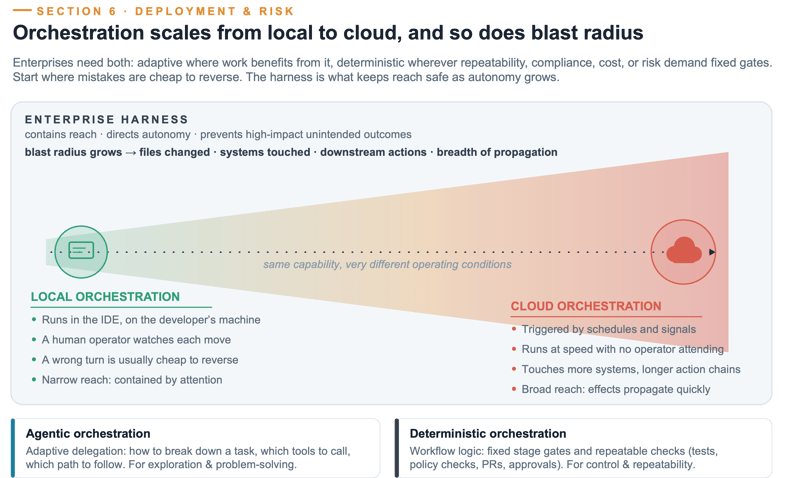
Orchestration starts locally: AI agents running on the developer's machine, inside the IDE, where a human sees each move and a wrong turn costs little to reverse.
From there, orchestration moves to the cloud: agents triggered by schedules and signals, running at speed with no one attending the screen. The capability may look similar, but the operating conditions are very different.
The blast radius is one of those differences. Here, blast radius means the scope and scale of what a single orchestration can affect: how many files can be changed, how many systems can be touched, how many downstream actions can be triggered, and how broadly the impact can propagate across services, teams, and business processes before a human intervenes. Recent reporting around Amazon’s outages illustrates the point: whether the root cause is framed as AI error or as user error amplified by weak permissions and outdated guidance, the lesson is the same. When orchestration has broad reach, unintended effects can propagate quickly and widely. That is precisely why the harness becomes critical: not to slow useful autonomy, but to contain it, direct it, and prevent high-impact unintended outcomes.
The move from local orchestration to cloud orchestration, with its broader blast radius, also makes it important to distinguish between two kinds of orchestration.
Agentic orchestration is the dynamic delegation of work to agents and sub-agents: deciding how to break down a task, which tools to call, and which path to follow. This is the part that frontier models are increasingly commoditizing and making more transparent through native planning, automated sub-agent creation, and built-in coordination and validation loops.
Deterministic orchestration, by contrast, is workflow logic: do this, then that, with predictable stage gates and repeatable checks. It can include non-LLM steps such as code-quality validation, policy checks, test execution, pull request creation, approval routing, or commits.
Enterprises need both: agentic orchestration for adaptive problem-solving, and deterministic orchestration for control, repeatability, and safely scaling autonomous agents in the cloud.
7. Context Engineering
Context engineering is evolving from flat repositories to knowledge graphs and vector databases
For enterprises, context is no longer just documentation that supports delivery. It is becoming an operational asset for agents: the layer that determines what they understand, how well they align to the business, and how safely they can act. That makes context engineering one of the most important control points in the harness.
Keeping context coherent in the repository remains the first step: requirements, architecture, transcripts, decisions, and delivery artifacts versioned alongside the code. But on its own, that is not enough for enterprise scale. The next step is to lift context from flat files into structures that agents can navigate, retrieve, and reason over more effectively across teams and projects.
Knowledge graphs provide that structure by modelling relationships explicitly: which regulation affects which service, which requirement traces to which system and test, which decision changed which interface, and which control applies to which workflow. They can also model how applications, services, APIs, data stores, and dependencies interact across the enterprise. For an enterprise, this is more than retrieval. It gives agents a governed map of dependencies, traceability, and impact, so they can reason on relationships instead of searching blindly through documents. That also makes knowledge graphs a powerful way to compute blast radius in a more reliable and autonomous manner, because the system can trace how a change may propagate before action is taken.
Vector databases solve a different problem: they make large bodies of unstructured material searchable by meaning rather than by file name or folder path. Transcripts, tickets, specifications, decisions, and documentation can be recalled when relevant, even when the wording changes. That gives agents broad semantic access to enterprise memory without forcing them to re-read everything every time.
Together, these structures move the enterprise from “the agent can find a file” to “the agent can navigate enterprise knowledge”. This is how L2 context matures from project support into enterprise understanding, and why it is becoming one of the major sources of quality, ROI, and differentiation in the harness.
One useful way to structure this is through Addressable Structured Knowledge Units (ASKUs): bounded, linked units of enterprise knowledge designed to be retrieved and injected at the right level of granularity.
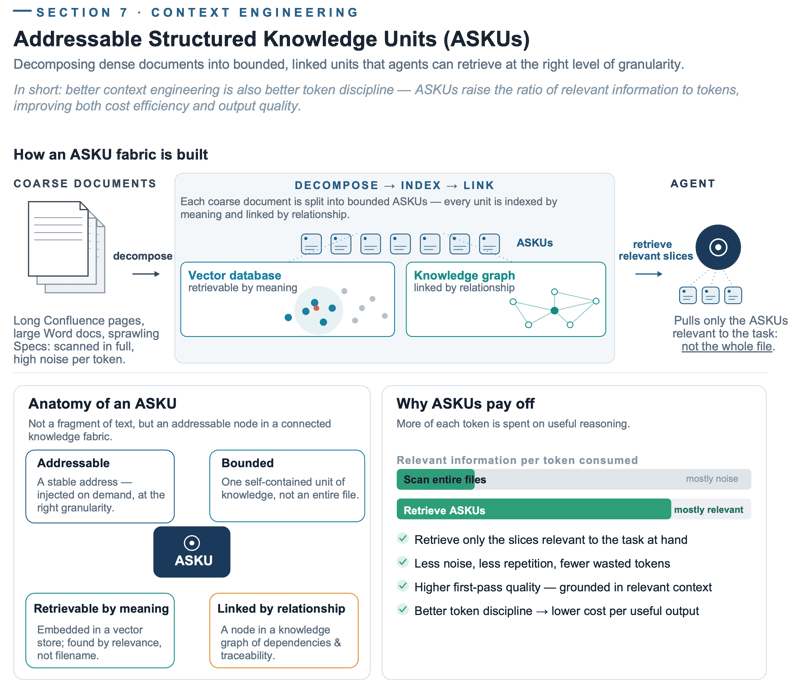
In practice, ASKUs are created by decomposing dense coarse documents, such as long Confluence pages, large Word documents, or sprawling specifications, into smaller knowledge units that can be indexed in vector databases and connected through knowledge graphs. Each ASKU is therefore not just a fragment of text, but an addressable node in a connected enterprise knowledge fabric: retrievable by meaning, linked by relationship, and positioned within a wider map of dependencies, context, and traceability.
This allows agents to retrieve only the slices of knowledge that are relevant to the task at hand, rather than repeatedly scanning entire files. The result is a higher ratio of relevant information to tokens consumed: less noise, less repetition, and more of each token spent on useful reasoning. In that sense, better context engineering is also better token discipline.
8. Tokenomics
Tokenomics and token optimization
A second challenge, after orchestrating agents at scale, is token economics. As enterprises move from occasional prompting to continuous agentic workflows, token consumption becomes a design concern rather than a billing detail.
Two years ago, AI was barely visible in most engineering budgets. Today it is becoming a line item because agents consume tokens continuously: breaking problems into sub-tasks, retrieving context, calling models repeatedly, and iterating through multi-step loops to solve larger problems.
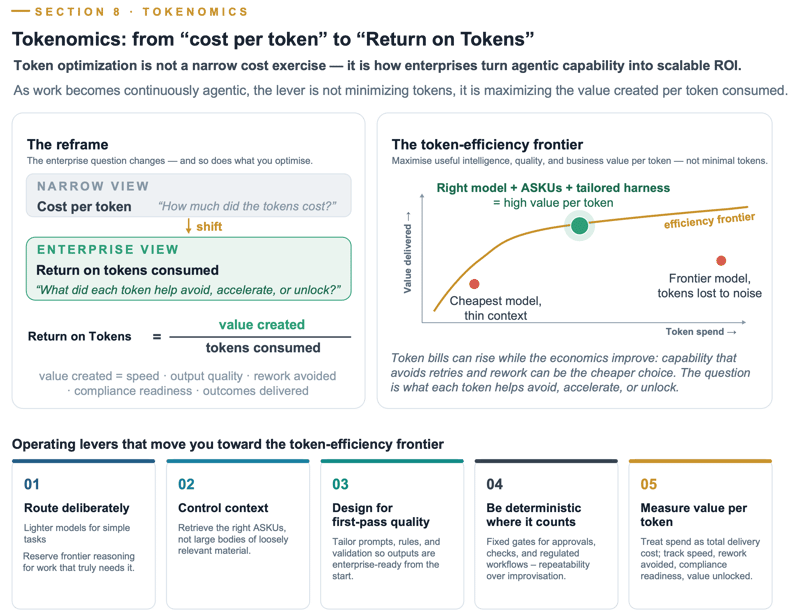
As frontier-model pricing has normalized around per-token economics, token discipline is becoming one of the clearest levers for controlling AI spend at scale.
But cost control is only half the equation. The enterprise question is not simply whether a model is expensive per token, but whether the value created per token is high enough to justify it. A more capable model can be the cheaper choice in practice if it completes higher-value work faster, with fewer retries, less human rework, and better downstream outcomes. In other words, the right measure is not token cost alone, but return on tokens consumed.
This is already visible in Gen-e2 delivery work such as impact analysis, migration planning, test generation, compliance evidence gathering, or production-ready documentation, where token bills can rise while the economics still improve dramatically because expensive human effort is compressed and cycle time is reduced. The question is not “what did the tokens cost?” but “what did each token help avoid, accelerate, or unlock?”
Context quality matters just as much. When enterprise knowledge is organized into ASKUs and retrieved at the right granularity, agents inject less noise, re-read less material, and spend fewer tokens locating what matters. Better context structure therefore improves both cost efficiency and the quality of the output, because the model starts from more relevant enterprise information in the first place.
Output quality also has an enterprise-specific economic effect. In regulated environments such as finance or healthcare, a generic harness may produce superficially good outputs, but not ones that are aligned to the enterprise’s own controls, evidence standards, approval rules, or audit requirements.
A harness tailored to that enterprise improves first-pass quality by grounding agents in its specific conventions and validation logic. That reduces repeated runs, corrective prompting, and remediation work.
It also lowers the cost of L5 activities such as evaluation, governance, compliance hardening, and audit preparation. In that sense, stronger enterprise harnessing increases not only output quality, but the return on every token consumed.
Optimized instructions matter too. Concise, reusable, and well-scoped prompts reduce token bloat from verbosity, duplication, and unnecessary back-and-forth across orchestration steps.
These outcomes depend on deliberate operating discipline. Using AI agents does not remove engineering responsibility; it increases the need for careful choices about scope, context, routing, and execution. In practice, this means:
- Route work deliberately: use lighter models for simple tasks, and reserve frontier reasoning for the work that truly needs it.
- Control context size through better structure: retrieve the right ASKUs rather than loading large bodies of loosely relevant material.
- Design for first-pass quality: tailor prompts, rules, and validation logic so outputs are closer to enterprise-ready from the start.
- Use deterministic orchestration where repeatability and control matter most, especially for approvals, checks, and regulated workflows.
- Treat token spend as part of total delivery cost, then measure how much speed, quality, rework avoided, compliance readiness, and business value that spend unlocks.
Our view is that the organizations that master these levers will find the right token-efficiency frontier: maximizing useful intelligence, output quality, and business value per token consumed. In practice, that means looking beyond model price to the combined economics of speed, relevance, rework avoided, compliance readiness, and outcomes delivered. Token optimization is therefore not a narrow cost exercise; it is part of how enterprises turn agentic capability into scalable ROI.
9. Agentic Debt
What accumulates when governance falls behind
Since the beginnings of the digital era, every technology we build eventually accumulates debt if left unmaintained. AI agents are no exception. Agentic debt is the accumulated gap between how an enterprise expects its agents to behave and how those agents actually operate over time: as context becomes stale, orchestration grows opaque, permissions drift, validation weakens, and governance falls behind the reality of production use. Compliance debt is part of that picture, but it is only one part. Agentic debt is broader because it also includes degraded context, weak execution patterns, poor verification, and the widening loss of alignment between enterprise intent and system behavior.
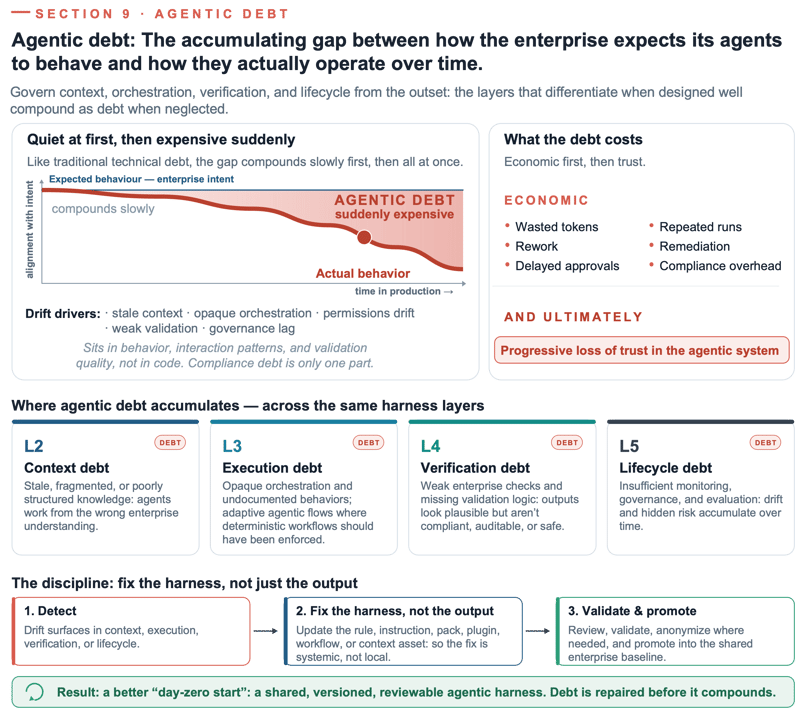
Like technical debt, agentic debt compounds quietly at first, then becomes expensive suddenly. It can accumulate across the same multiple layers of the harness:
- L2 – Context debt: stale, fragmented, or poorly structured knowledge that causes agents to work from the wrong enterprise understanding.
- L3 – Execution debt: opaque orchestration, undocumented agent behaviors, or the use of adaptive agentic flows where deterministic workflows should have been enforced.
- L4 – Verification debt: weak enterprise-specific checks, missing validation logic, and outputs that appear plausible but are not actually compliant, auditable, or safe to use.
- L5 – Lifecycle debt: insufficient monitoring, governance, evaluation, and improvement, leaving drift and hidden risk to accumulate over time.
The cost of that debt is not only technical. It shows up economically as wasted tokens, repeated runs, rework, remediation, delayed approvals, compliance overhead, and a progressive loss of trust in the agentic system. Where classic technical debt sits in code and architecture, agentic debt sits in behavior, interaction patterns, validation quality, and the widening gap between what the enterprise believes the system is doing and what it is actually doing.
This is why enterprise harness discipline cannot be deferred. The same layers that create differentiation when they are designed well become sources of compounding debt when they are neglected. If organizations want agentic systems to scale safely, economically, and credibly, they must govern context, orchestration, verification, and lifecycle control from the outset rather than trying to repair the consequences later.
Gen-e2 addresses this by treating the harness as a shared enterprise asset rather than a project-by-project workaround. The durable parts of the system - rules, instructions, agents, skills, packs, plugins, and validation workflows - are managed as part of a shared enterprise harness layer, not left scattered across individual projects.
That layer is more than a place to store instructions. It includes agents that help teams find, deploy, and customise the right packs; metadata and documentation that make those packs understandable and governable; workflows that validate instructions; and supporting mechanisms such as anonymization prompts and compression layers that turn project-specific guidance into reusable enterprise assets.
This gives teams a better starting point from day zero. They do not begin from a blank slate, and they do not have to rediscover the same controls, patterns, or validation logic on each project. In practice, this reduces drift in context, execution, and verification because the baseline is shared, versioned, reviewable, and accessible to both human teams and autonomous agents.
It also changes how debt is corrected once it appears. In Gen-e2, the goal is to fix the harness, not just the output: update the rule, the instruction, the pack, the plugin, the workflow, or the context asset so the improvement becomes systemic rather than local.
That maintenance is not only the responsibility of project teams. Domain SMEs also play a central role. For instance, security teams maintain and validate the packs and rules for software and infrastructure security, while architecture teams do the same for design and validation harnesses used by delivery teams and autonomous agents. The same pattern extends across compliance teams, development teams, QA teams, and beyond.
In that sense, the role of expertise starts to change. It is no longer only about doing the work directly; it is increasingly about codifying how the work should be done, so that validated knowledge, controls, and operating patterns can be reused at scale.
This also has an impact on people and roles. As agentic systems take on more delivery work, some expertise shifts from performing every task directly to shaping how the work should be done: defining reusable patterns, maintaining rules and packs, validating outputs, and improving the enterprise harness over time. In that sense, the talent model evolves alongside the technology. The highest-value contributors are not only those who can execute well themselves, but also those who can encode, govern, and continuously improve the knowledge and controls that allow many teams and agents to execute well at scale.
At PALO IT, we have structured this promotion path through the Gen-e2 marketplace and pack model. Packs and plugins become easier to discover, govern, and distribute; project-level improvements can be reviewed, validated, anonymized where needed, and promoted upward into the wider enterprise baseline. Combined with regular review of context, rules, and validation logic, this provides a practical mechanism not only for preventing agentic debt, but for repairing it before it compounds.
10. The Operating Model
Operationalizing the enterprise harness in practice
At PALO IT, we use the Enterprise Harness to turn these ideas into an operating model that enterprises can actually run. The point is not simply to add tools around the model, but to put in place the context, execution patterns, validation logic, and lifecycle discipline required for agentic systems to work reliably beyond isolated experiments.
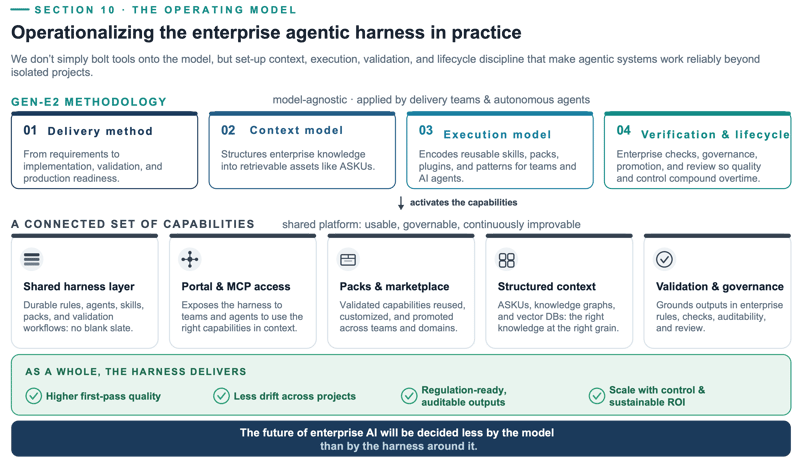
In practice, that means relying on a connected set of capabilities to operate at scale and make the harness usable, governable, and continuously improvable in an enterprise environment:
- A shared enterprise harness layer that holds the durable parts of the system - rules, instructions, agents, skills, packs, plugins, and validation workflows - so teams do not start from a blank slate.
- A portal and MCP-enabled access layer that exposes the harness to delivery teams and autonomous agents, making it easier to discover, retrieve, and use the right capabilities in context.
- Packs, plugins, and a governed marketplace that allow validated capabilities to be distributed, reused, customized, and promoted across projects, teams, and enterprise domains.
- A structured context layer based on ASKUs, knowledge graphs, and vector databases, so agents can retrieve the right knowledge at the right granularity instead of repeatedly scanning coarse documents.
- Validation and governance workflows that ground outputs in enterprise-specific rules, checks, auditability, and lifecycle review rather than relying on generic model behaviour alone.
These capabilities are activated through the Gen-e2 methodology, which remains model-agnostic even as frontier platforms keep evolving. In practice, Gen-e2 provides a disciplined way to structure context, encode know-how, guide orchestration, validate outputs, and continuously improve the harness over time.
- A delivery method that guides teams from requirements to implementation, validation, and production readiness.
- A context model that structures enterprise knowledge into retrievable assets such as ASKUs, making context easier to reuse, govern, and optimise.
- An execution model that encodes reusable skills, packs, plugins, and operating patterns for both human teams and autonomous agents.
- A verification and lifecycle model that applies enterprise-specific checks, governance, promotion, review, and continuous improvement so quality and control compound over time.
Taken together, these elements provide a way to operationalize the harness as an enterprise system: one that improves first-pass quality, reduces drift across projects, produces more regulation-ready and auditable outputs, and makes agentic work easier to scale with control and sustainable ROI.
11. Conclusion
The future of enterprise AI will be decided less by the model than by the harness around it
Frontier models will continue to absorb more generic capability: more planning, more orchestration, more self-checking, and more native control.
But that will not reduce the importance of enterprise discipline; it will increase it. As models become more capable, more autonomous, and more widely deployed, the real sources of differentiation move upward into the harness: the quality of context, the structure of execution, the strength of verification, and the discipline of lifecycle governance.
This is where value, trust, and control will increasingly be won or lost.
The organizations that treat the harness as a strategic enterprise asset - not just a technical wrapper around the model - will be the ones that scale agentic systems safely, credibly, and economically.
About PALO IT
PALO IT is a global, AI-first technology consultancy, with a trademarked engineering approach for accelerating the delivery of digital products, and revolutionizing platform modernization.