



Ready to kickstart your next big project?
Let's innovate together.
GitHub Universe 2026 brought thousands of developers, platform engineers and technology leaders to Fort Mason in San Francisco, and the PALO IT team was on the ground, from Asia Pacific, Europe and the Americas. It was a special week for us, as we won the 2026 GitHub APAC Services and Channel Partner of the Year award, our third year running as a GitHub Partner of the Year award winner.
We came to listen, meet and plan, and our team met with GitHub leadership and partner teams to strengthen a relationship we've built over several years. We sat down with clients and prospects alike to talk about where agentic engineering is heading, and took in as many sessions as we could. Our Co-Founder and APAC CEO, Tanguy Fournier Le Ray, even made it into Microsoft's own Universe recap, pictured in conversation with Jay Parikh, Executive Vice President at Microsoft.
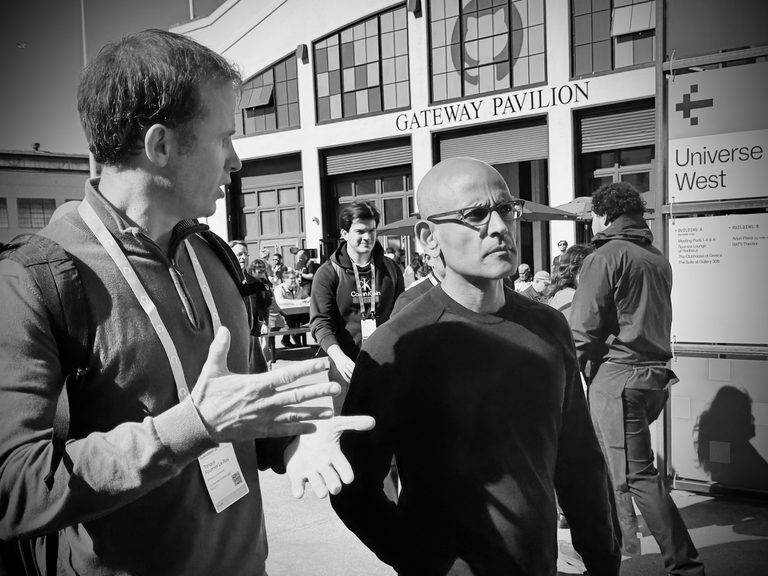 Tanguy Fournier Le Ray and Jay Parikh at GitHub Universe 2026
Here's a quick look at what we took away from the event, and what it means for the organizations we work with.
The software lifecycle is no longer a straight line
The theme running through every keynote and hallway conversation was simple: agents are no longer an experiment. GitHub's annual Octoverse report, released on the first day of the event, found that by September more than 40% of pull requests began as a draft from an AI agent, up from 17% in March. Developers pushed code 17.9 billion times over the past year, more than in the previous two years combined.
GitHub framed the response as an agentic software delivery system built around three things: velocity, intelligence and quality. In Microsoft's own words, the software lifecycle is no longer a linear path from planning to coding to testing to deployment.
We agree, and it's the reason we built Gen-e2™. When AI can take centerstage in every part of delivery, the question for enterprises is no longer which tool to buy, but how to redesign the way their teams work so that people and agents are productive together, safely, at scale.
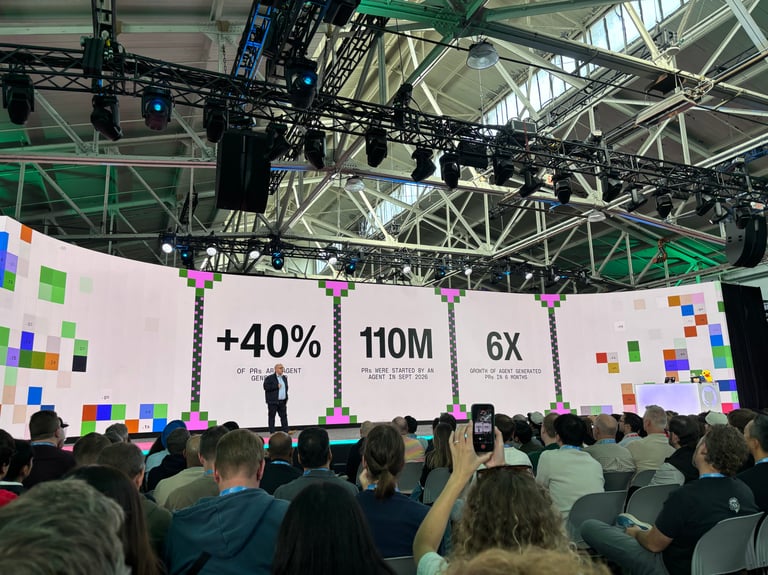 GitHub Universe keynote – statistics on AI agents in 2026
1. Context is the new bottleneck
Many of this year's announcements were about giving agents more continuity. GitHub showed agent work running across several repositories in parallel sessions, and agent sessions that move between the command line, the editor and the web without losing their place.
The message underneath is that an agent is only as good as what it knows about the project. An agent that has to rebuild its understanding of a codebase every session produces inconsistent work, and it makes humans re-explain the same things over and over.
This is a problem we designed Gen-e2™ to solve. At its center is a single product repository that holds not just code but requirements, designs and architecture decisions, alongside instructions, skills and agents curated from years of enterprise delivery experience. It gives AI the full context of a product from day one, so every agent and every engineer works from the same source of truth. The platform capabilities announced at Universe make that approach more powerful, but the discipline of structuring context still has to come from the actual team.
2. More orchestration means more need for human judgment
The headline launch was Copilot Fusion, which decides which AI model (or combination of models) should handle each step of a coding task. Depending on the task, it can solve the problem directly, escalate to a stronger model or bring in an independent review. GitHub also introduced a more rigorous AI code review option aimed at catching high-severity issues.
It's a very clear signal of where the industry is going. AI systems are starting to check and correct each other, not just generate code. That's a welcome step! But, in our experience, especially on complex and business-critical systems, automated review complements experienced engineers rather than replacing them.
Human-in-the-loop validation is built into every stage of Gen-e2™. On our largest modernization programs, every AI-generated component is reviewed by engineers who understand the business domain and tested against known-correct results before it's accepted. That's what lets clients trust AI-assisted delivery in production. Smarter orchestration makes each review faster, it doesn't make the review optional.
3. The economics of AI are shifting from seats to consumption
One of the most consequential announcements wasn't a feature at all. GitHub Enterprise customers can now use every Copilot feature without buying a separate subscription, paying instead for the AI credits they consume.
Removing the seat decision will make AI far easier to roll out across an engineering organization. It also changes the question leaders need to answer. When usage is metered from the first request, the conversation moves from "Who gets a license?" to "Where is our AI spend creating value, and where is it being wasted?"
This is where we see many organizations underprepared. Getting real value from consumption-based AI takes governance: clear policies and budgets, visibility into how agents and teams use tokens, and a way to connect that spend to delivery outcomes. It's an area we've been investing in heavily, and it was one of the most common topics in our conversations with clients at Universe.
4. The real work is moving past the pilot
One session title summed up the mood of the week, "Agentic engineering past the pilot: An enterprise playbook." The industry has moved from code completion > chat > agents, and now > AI-native software delivery. Yet inside most enterprises, governance, developer experience and adoption at scale still have to be made to work together.
That gap between experiment and operating model is exactly where we spend our time. The organizations that succeed treat AI adoption as a change in how they work, not a licensing exercise. They pick real use cases, measure outcomes, and build capability and culture inside their own teams.
That's why enablement is part of every PALO IT engagement from the start, not an afterthought at handover. Through the Gen-e2™ Harness, our library of reusable enablement assets, combined with hands-on enablement, the new way of working is already in place, and understood, when we step back.
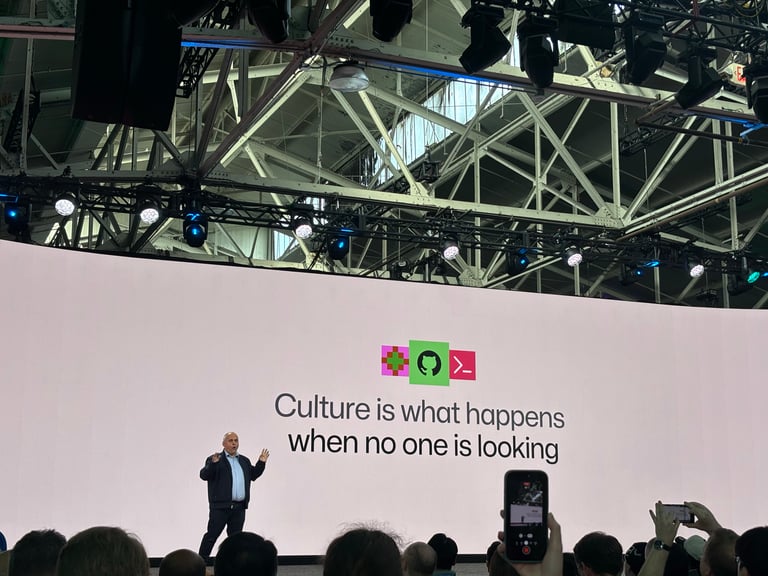 GitHub Universe keynote – thoughts on team culture
What we're bringing home
We left San Francisco with a stronger partnership with GitHub, new conversations with organizations across Asia Pacific, Europe and the Americas, and a clearer view of where agentic engineering is heading. Above all, Universe confirmed the direction we've been building toward with Gen-e2™: the advantage won't go to the teams with access to "the most AI," but to the teams that know how to put it to work with the right human oversight and governance to shape the future of the frontier enterprise
A big thanks to GitHub for yet another outstanding event, and to everyone who took the time to meet with us.
Want to explore what AI-first engineering could look like in your organization? Get in touch with our team.