




Ready to kickstart your next big project?
Let's innovate together.
In our earlier guide to AI tokenization, we covered what tokens are, how models break information into them, and why every token carries a cost. This post picks up where that one left off, with the question most enterprise teams are now asking: once AI agents are running across dozens of projects, how do you actually know where your tokens are going?
That discipline has a name: AI tokenomics.
What Is AI Tokenomics?
AI tokenomics is the practice of measuring, attributing, and managing token consumption across an organization's AI systems, so that spend can be tied to specific work, teams, and outcomes. It treats tokens the way finance teams treat any other operating cost: something to forecast, allocate, and optimize.
(If you've come across "tokenomics" in crypto, that's a different concept, describing the supply and distribution of a digital currency. In enterprise AI, the term refers to the economics of model usage.)
For many organizations, AI costs started as a line item nobody watched closely, a few coding assistant seats, some API experiments. That changed as agentic workflows scaled and pricing models for AI development tools shifted. Suddenly, the same questions landed on engineering leaders' desks everywhere. How much are we spending? On what? Is it really worth it??
Why Is Token Usage So Hard to Track?
The problem isn't that token data doesn't exist. Every model provider logs input and output tokens, and most development platforms offer some usage reporting. The problem is that this data is organized around the tool, not the work.
A typical AI coding platform understands sessions (a developer opens a chat) and rounds (each exchange within that chat). What it doesn't understand is what those sessions were for. Was that 40,000-token session writing a user story, generating test data, or refactoring a legacy module? From the platform's perspective, it's all just traffic.
In an agentic development lifecycle, that gap matters a great deal. Work is performed by specialized agents executing commands with clear business meaning: create an epic, write an implementation plan, execute the plan, build functional tests. That's the level where engineering leaders make decisions, and it's precisely the level native tooling can't see.
Agent commands sit between sessions and rounds, and they carry a meaning for the software delivery process that the underlying platform simply has no way to access.
The Levels of Token Attribution
Not all token data is equally useful. The further you move from raw sessions toward units of business value, the more actionable the data becomes, and the less likely you are to get it out of the box.
| Attribution level | Question it answers | Typically available from |
|---|---|---|
| Session / round | What did this conversation cost? | Native platform reporting |
| Model | Which models are driving spend? | Provider APIs, platform dashboards |
| Command / task | What did this unit of work cost? | Custom instrumentation |
| Agent | Which role in the workflow consumes the most? | Custom instrumentation |
| Epic / feature | What did this feature cost to build? | Instrumentation linked to the backlog |
| Project / client | How does spend compare across teams? | Centralized aggregation |
Most enterprises today have the first two rows. The value lives in the last four.
What Granular Tracking Reveals: A Real-world Example
To close this gap, PALO IT built Tokenomics, a platform that captures and visualizes token consumption by command, agent, epic, and model across projects delivered with our Gen-e2™ methodology.
It started simple. On an engagement with a fortune 500 enterprise client earlier this year, the team logged input, output, and cached tokens for every agent command in a spreadsheet. Roughly six weeks of real delivery data became the foundation of the platform's first dashboard.
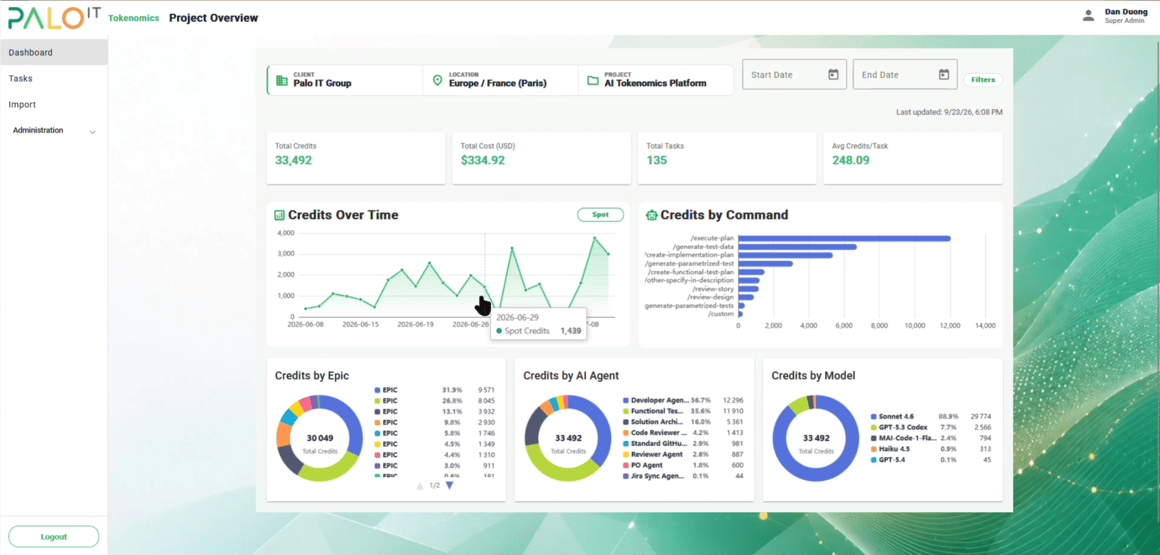
What's notable in our example, is that the team expected the product owner agent, which ingests requirements documents at the start of every feature, to be among the heaviest consumers. In reality, the functional test agent, meanwhile, consumed around 36%, nearly matching the developer agent that writes the actual code.
The model breakdown also told its own story: nearly 89% of credits went to a single high-capability model, a useful prompt to ask whether every task genuinely needed it.
The lesson isn't really about test agents. It's that intuition about where AI spend concentrates is often wrong, and you can't correct what you can't see.
From One Project to a Portfolio
A single project gives you a baseline. Real insight comes from comparison. Once token data is captured consistently across projects and clients, outliers become visible in both directions.
A project consuming far more than its peers usually has a reason worth diagnosing: a poorly scoped agent, redundant context loading, or the wrong model for the job. A project consuming far less is just as interesting. It may signal a gap in data capture, or it may be a team that has figured out something everyone else should learn from.
This is also why governance matters as much as the charts. Enterprise token tracking has to answer who can see what. A squad member views their own project, a client admin sees every project for that client, and a regional lead sees all projects in a geography. Tokenomics handles this through role-based access grants scoped by client, project, and location, with sign-in through both PALO IT and client identity providers for blended teams.
Making Measurement Painless
The biggest barrier to token tracking isn't tech. It's friction. Manual logging works for a pilot, but no developer wants to sit there and copy token counts into a form after every command, and data quality degrades fast when capture depends on memory.
The durable answer is automation. The next step for Tokenomics is having agents report their own consumption. At the end of each command, the agent posts its token usage to the platform, with the instruction built directly into the Gen-e2 agent artifacts. When capture is automatic, tracking stops being a request and becomes a policy. Every project is measured by default, at no cost to the people doing the work.
Practical Steps for Enterprises
Whether you build your own tracking or adopt an existing tool, a few principles apply:
- Define your unit of work. Decide what "a task" means in your delivery process, and track at that level rather than by session alone.
- Capture the full token breakdown. Input, output, and cached tokens are priced differently. Lumping them together hides optimization opportunities.
- Tag everything from day one. Agent, model, feature, project, team. Attribution you don't capture upfront is nearly impossible to reconstruct later.
- Automate capture. Build reporting into the agent workflow itself.
- Compare before you optimize. Look for outliers across projects before redesigning individual agents.
- Tie cost to outcomes. The real metric is cost per successful outcome, not raw consumption.
FAQ
PALO IT is a global, AI-first technology consultancy helping organizations design and deliver AI systems that are transparent, auditable, and cost-efficient at scale. To learn how your teams can get visibility into AI token spend, get in touch.